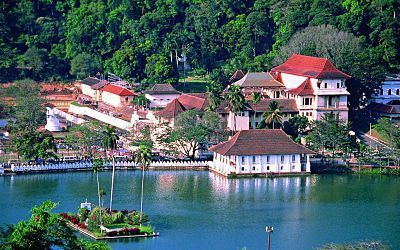


Sacred Ceremonies and Rituals for Lord Buddha at the Temple of the Tooth Relic
The illustrious disciple Ananda Thero was the principal personal assistant to the living Buddha. He held a pure, infinite affection and deep respect for the Lord Buddha, dedicating his entire life to his service.
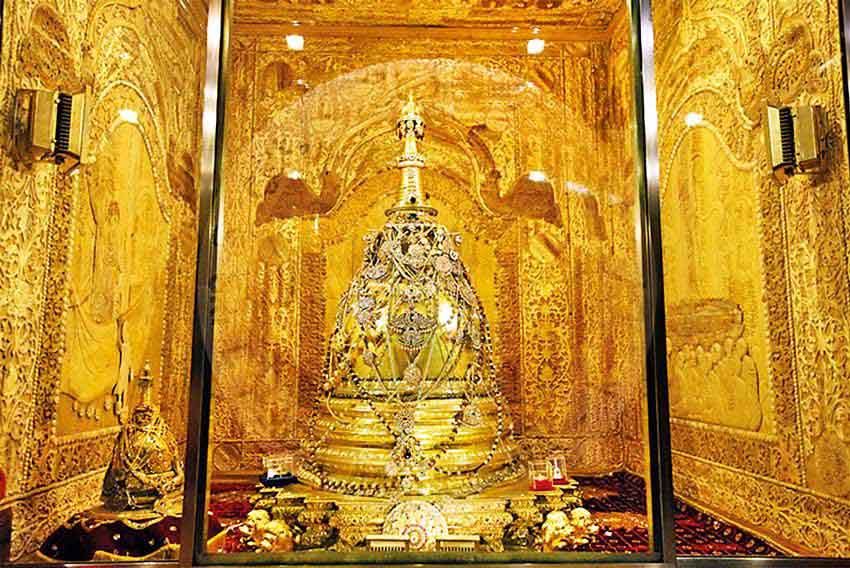
The poojas and sacred rituals that Ananda Thero offered to the living Buddha are still practiced today as “Theva” (daily services), led by the Maha Nayaka Thero of the Malwathu and Asgiri chapters, with the participation of the resident clergy dedicated to maintaining these ancient traditions.
The Traditional Theva Service of the Sacred Tooth Relic
Every year, the responsibility for the daily service (Theva) is exchanged between the two main chapters — Malwathu and Asgiri — at the beginning of the rainy retreat (Vassana retreat), right after the Esala Poya full moon day.
During this ceremony, under the guidance of the Maha Nayaka Theros and the Diyawadana Nilame (Chief Custodian of the Temple), the Secretary Mohottala reads the inventory of the treasures preserved in the different levels of the temple — Ihala Malaya (upper floor), Pahala Malaya (lower floor), and Paththirippuwa (octagonal pavilion).
The items are displayed, handed over, and officially signed for by the Mahanayaka Theros and the Diyawadana Nilame, thus completing the transfer of keys and responsibilities.
For a monk, leading the Theva service is considered a great honor and blessing.
A notable chapter in its history occurred during World War II, when Lord Louis Mountbatten, Supreme Commander of the Allied Forces in South Asia, used the garden as the headquarters of the Southeast Asia Command. The building from which he planned the Allied strategy in Asia remains in perfect condition.
The Daily Theva Service
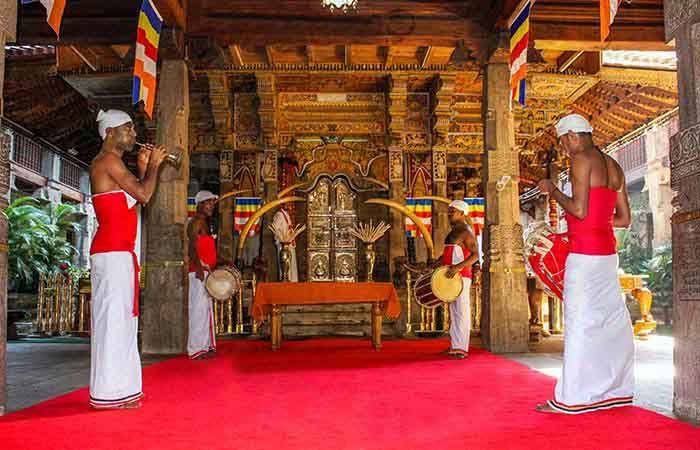
The daily rituals dedicated to the Sacred Tooth Relic are called “Theva”, and they consist of three main sessions:
Morning Service
Midday Service
Evening Service
During each service, jasmine flowers (Saman Pichcha), food, and beverages are offered, accompanied by traditional ceremonial sounds.
Service Schedule:
Morning Service: 5:30 – 7:00 a.m.
Midday Service: 9:30 – 11:00 a.m.
Evening Service: 6:30 – 8:00 p.m.
The Morning Service
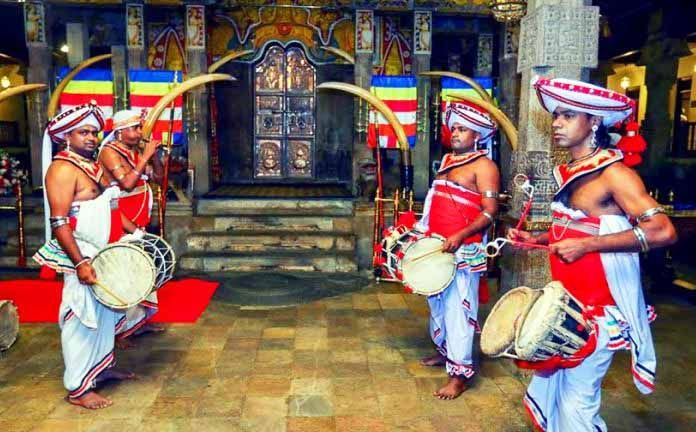
The morning service begins at 5:15 a.m. with the sound of the Hewisi drums. The silver and gold doors are opened in sequence, and the devotees can witness the offering of fresh flowers and the removal of the previous offerings.
The ceremonies are conducted with deep devotion and follow a precise order. Only the designated monk is allowed to handle the silver and gold vessels used during the ritual.
The Midday Service
The midday service, called “Buddha Pooja”, begins around 9:30 a.m. and ends at 10:30 a.m. This is the time when the daily food offerings are made to the Lord Buddha.
After the flowers are prepared and replaced, the officer known as the Geparala presents a silver tray with jasmine flowers, followed by the offering of food by the monks and temple attendants.
The ceremony concludes with the closing of the doors and the solemn sound of the ceremonial Maghul Bera drums.
The Evening Service
Please Give me aspaniIl servizio serale si svolge dalle 6.30 p.m. alle 7.15 p.m.Durante questa cerimonia vengono offerte bevande e dolci al Signore Buddha, come Gilan Pasa, miele, succo di zenzero, burro chiarificato (ghee) e linfa di palma di kithul, serviti in coppe d’oro e d’argento. Questa tradizione risale al regno del Re Keerthi Sri Rajasinghe, che introdusse la seconda offerta di “Gilanpasa.
Amuthu Muluthen Poojawa
This ritual, introduced by the royal palace and later adopted by the Temple of the Tooth Relic, involves the preparation of 32 large servings of curry and rice as a demonstration of the king’s respect and devotion to the Sacred Relic.
Today, the quantity has been reduced, but the ceremony continues to be performed with the same dedication and solemnity as in ancient times.
Conclusion
The rituals and poojas of the Temple of the Sacred Tooth Relic represent a living connection to the time of the Buddha and embody the continuity of Buddhist faith and devotion.
Every service, sound, and offering is an act of deep respect toward the Lord Buddha, preserving a spiritual heritage that for centuries has enriched the cultural and religious soul of Sri Lanka.
Today, the quantity has been reduced, but the ceremony continues to be performed with the same dedication and solemnity as in ancient times.